How to Get the Art Deco Bathroom Look in a Weekend (No Renovation Required)
Skip the tile reno. Three surface-level swaps, curved mirror, fluted glass, unlacquered brass, bring real Art Deco style to any bathroom for under $300.
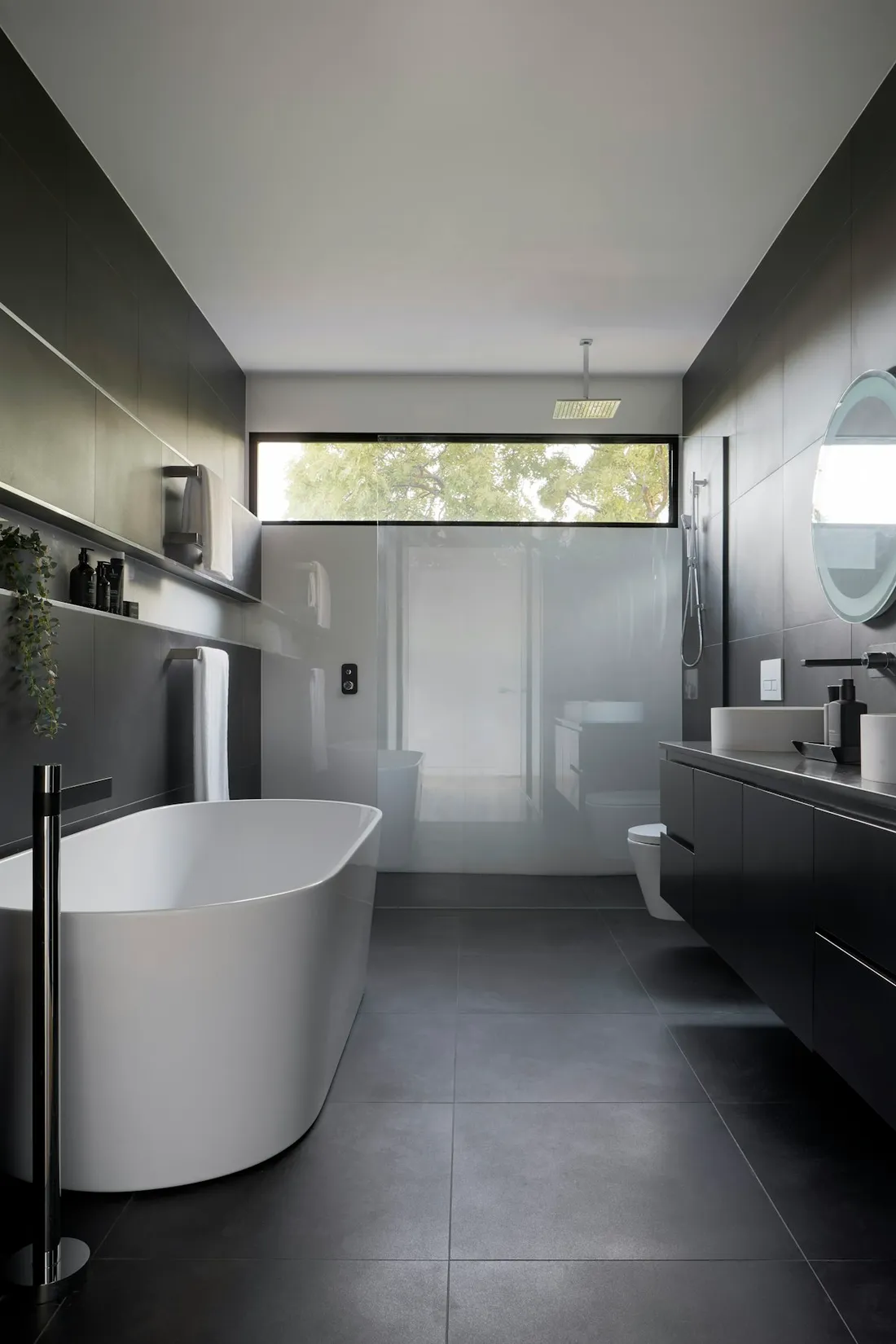
Every Art Deco bathroom guide on the internet starts the same way: rip out your floor, install black-and-white encaustic tile, add a clawfoot tub. That’s a $15,000 renovation, minimum. It’s also not the part of Art Deco that actually makes a room feel Art Deco. I know this because I spent six months staring at my builder-grade beige bathroom trying to figure out what would make it stop looking like a mid-2000s model home. The answer wasn’t tile. It was three things I could install with a screwdriver and a Sunday afternoon.
Art Deco’s Biggest 2026 Comeback, and Why It Doesn’t Look Like You Think
Art Deco is having a moment again, but the version showing up in 2026 doesn’t look like a Gatsby set piece. It’s quieter. Warmer. The geometric rigidity of 1920s Deco has softened into something that plays nicely with modern bathrooms: curved mirrors instead of sharp angles, warm brass instead of chrome, fluted glass that catches light without screaming “theme room.”
The original movement (roughly 1920–1940) pulled from Egyptian art, Bauhaus geometry, and early machine-age manufacturing. What survived wasn’t the gold leaf and the marble columns. It was the visual grammar: repeating vertical lines, arched forms, and warm metallics against clean surfaces. That grammar is what you’re recreating. Not a period replica.
This matters because it means you don’t need to gut your bathroom. You need to speak the same visual language with a few well-chosen pieces. The bones of Art Deco (the curves, the fluting, the brass) are all surface elements. They sit on top of whatever tile you already have.
The Three Elements That Define the Look (Hint: Not the Tile)
If you stripped every Art Deco bathroom down to its visual DNA, you’d find the same three signatures repeating:
- Curved forms: arched mirrors, rounded vanity edges, scalloped details. Deco loved the arch because it softened industrial geometry. Your eye reads “curved mirror” and “arched doorway” and files it under the same aesthetic category, even if the rest of the room is completely modern.
- Fluted or ribbed texture: the vertical ridging you see on columns, glass shades, and cabinet panels. This is Deco’s most recognizable texture. A single fluted glass sconce does more to signal the style than an entire room of subway tile.
- Warm metallics: brass, gold, and bronze, specifically with some patina or aging. Chrome reads mid-century modern. Polished nickel reads contemporary. Brass reads Deco. The temperature of your metal is doing more work than you think.
The tile? It’s set dressing. A beautiful black-and-white floor is gorgeous, but it’s not what your brain registers as “Art Deco.” Your brain registers the shapes, the textures, and the metal tones. Everything else is context.
Hardware First: Why the $28 Swap Has More Impact Than the $200 Mirror
Here’s the thing nobody tells you about bathroom upgrades: hardware is the highest-impact, lowest-cost change you can make in any room, and it’s especially true for Deco. I learned this backwards.
I’d been saving up for an arched mirror (a real one, not the flimsy Amazon versions) and I figured that was the move that would change everything. While I waited, I swapped out the brushed nickel cabinet pulls and towel bar for unlacquered brass. Total cost: $28 for two Amerock Highland Ridge pulls ($8 each) and a 24-inch towel bar from the same line ($12). I kept the old hardware in a labeled bag so I could reinstall it before moving out. (Renter brain. It’s a lifestyle.)
The difference was immediate. Not subtle. Immediate. The beige tile, which had always looked like “cheap builder grade,” suddenly looked like “warm neutral backdrop.” The brass gave the room a temperature, literally and visually. It went from feeling cold and generic to feeling like someone lived there and had opinions.
When I finally got the mirror a month later, it was beautiful. But it was a 20% improvement on top of the 80% the hardware had already done. If you only have $30, skip the mirror. Swap the hardware. You’ll be shocked.
This is consistent with something I’ve noticed across every room I’ve worked on: the things you touch matter more than the things you look at. A brass drawer pull has weight to it. You feel the slight resistance of solid metal when you open the vanity. Unlacquered brass develops a patina from your hands over time, and it’s literally shaped by your use of it. That tactile quality is what separates a room that looks styled from a room that feels considered.
Curved Mirrors, Fluted Glass, Unlacquered Brass: A Sourcing Guide at Three Price Points
I’ve tested a lot of products in the last year. Some held up. Some didn’t. Here’s where I’d spend at each budget level.
Mirrors (the arch is doing the work)
- Budget: The IKEA LINDBYN arched mirror ($30) is thin but serviceable. It’s 20” wide, which works in most bathrooms. The frame is black, which reads Deco-adjacent if you’ve got brass elsewhere to warm it up.
- Mid: Target’s Threshold Arched Metal Frame Mirror in brass ($80) has better proportions and actual weight to it. It feels like a $150 mirror. This is the one I bought.
- Investment: Rejuvenation’s Arched Metal Framed Mirror ($195+) comes in unlacquered brass and aged brass finishes. It’s the real deal, solid construction, beautiful patina potential. If you’re going to own one mirror for the next decade, this is the one.
Sconces (fluted glass is your Deco shortcut)
Lighting changes everything in a bathroom, and I’ve written a whole post about why: The Only Lighting Guide You Need for Every Room in Your Home. But the short version for Deco specifically is this: you want fluted or ribbed glass with a warm brass base.
- Budget: The Globe Electric Mercer 1-Light Sconce ($35) has a fluted glass shade and a brass-tone finish. It’s not real brass, but at arm’s length in a bathroom, it reads correctly.
- Mid: Wayfair’s Corrigan Studio line has a few fluted glass options in the $70–$90 range that look significantly more expensive than they are. Search “fluted glass wall sconce brass” and sort by rating.
- Investment: Schoolhouse’s Allegheny Sconce ($180) is handmade in Portland. (Yes, I’m biased. No, I don’t care. It’s a gorgeous light.) The fluted glass is thick, the brass is real, and it’ll outlast three apartments.
One note on sconce installation: most bathrooms already have a light fixture above the mirror. You’re not adding a new electrical box; you’re swapping what’s already there. If your current fixture is hardwired, this is a 20-minute job with a screwdriver and a YouTube video. Turn off the breaker first. I’m not going to be responsible for anyone’s electrical mishaps.
Hardware (the $28 game-changer)
- Budget: Amerock Highland Ridge pulls in Champagne Bronze ($6–$10 each at Home Depot). The “champagne bronze” finish is Amerock’s version of warm brass, and it’s very convincing. This is what I used.
- Mid: CB2’s Hex Brass Knobs ($13 each) are chunkier and more geometric, very Deco. They work beautifully on vanity drawers.
- Investment: Rejuvenation’s Massey Collection in unlacquered brass ($18–$30 per piece). Real brass. Will patina. Worth it if you own the place.
Don’t forget the towel bar and toilet paper holder. Switching those to match your new pulls ties the whole room together. It sounds minor. It isn’t.
Can You Pull Off Art Deco Without Touching Your Tile?
Yes. I’m going to say this more directly than most design writers will: your tile doesn’t matter as much as you think it does.
I know that’s a hard sell. Tile is the biggest surface in most bathrooms and it feels like the foundation of everything. But here’s what I’ve found after testing this in my own beige-tile bathroom, in my friend Sarah’s white-subway-tile guest bath, and in my partner Danny’s mom’s aggressively terracotta 1992 situation: the three swaps work across all of them.
The reason is that Art Deco’s visual language operates at a different layer than the tile. Curved forms, fluted texture, and warm brass create a cohesive style story that your eye reads as intentional, regardless of what’s behind them. It’s the same principle that makes a well-chosen piece of art work on any wall color. The tile becomes the backdrop, not the star.
There are limits. If your tile is extremely busy (think multi-colored mosaic or those ’70s floral patterns), the Deco elements will compete rather than layer. In that case, you’re better off leaning into what you already have. (A Mediterranean or bohemian direction might serve you better. I covered some of those ideas in How to Nail Mediterranean Style Without Making Your Home Look Like an Olive Garden.)
But standard builder tile? White subway? Beige ceramic? Even black hex? All of those are neutral enough to disappear behind strong Deco accessories. The tile becomes a canvas. Let it.
The Weekend Sequence: What to Install First and Why Order Matters
You’ve got your pieces. Here’s the order that makes the most visual sense and avoids unnecessary rework.
Saturday morning: Hardware. Start here because it’s the fastest win and it’ll motivate you for the rest of the project. Remove your existing pulls, knobs, and towel bar. (Bag and label everything if you’re renting.) Install the new brass hardware. Stand back. Feel unreasonably good about $28.
Saturday afternoon: Sconce. Turn off the breaker for your bathroom circuit. Remove the existing light fixture, note how the wires connect (take a photo if you need to), and install the new sconce. This is also when you’ll notice whether your mirror needs to move. The sconce establishes the vertical center point of your vanity wall, and the mirror should relate to it.
Sunday morning: Mirror. Hang the mirror last because its position depends on the sconce placement. If you’re going with a single arched mirror centered above the vanity, the top of the arch should sit 2–4 inches below the sconce (or flanked by sconces if you have two). Use a level. I didn’t use a level the first time and the mirror hung at a slight angle for two weeks before Danny said something. (He waited two weeks. That’s love.)
Sunday afternoon: Accessories. This is the detail pass. Swap your soap dispenser for one in amber glass or matte brass. Add a small fluted vase, even an empty one. If you’ve got open shelving or a countertop that needs corralling, that’s a storage problem with Deco-friendly solutions. I covered this in Creative Small Bathroom Storage Ideas That Actually Work.
The whole sequence takes 4–6 hours of actual work, spread across two days. Most of that is the sconce installation, which sounds scarier than it is.
What Your Accessories Can Do That a Renovation Never Could
Here’s the part that surprises people: a renovated Art Deco bathroom is locked in. It’s gorgeous, but it’s permanent. The tile is the tile. The vanity is the vanity. You’re committed.
A surface-level Deco bathroom is alive. You can swap the mirror next year. You can upgrade the sconces when you find the perfect vintage pair at an estate sale. You can add a brass tray this month and a fluted glass tumbler set next month. The room evolves because nothing is fixed.
I’ve changed my bathroom accessories three times in the last year. The hardware and sconce have stayed; they’re the foundation. But the mirror went from the IKEA LINDBYN to the Target Threshold version. The soap dispenser has been three different things. The small shelf above the toilet has held a fluted bud vase, then a brass catchall dish, then both. Each version felt like a different room. That’s not possible when your design is in the walls.
The accessories are also where you get to break the rules a little. Art Deco in its purest form is symmetrical and precise. But a slightly imperfect handmade ceramic dish, or a vintage brass box you found at Goodwill that’s a little tarnished, those are the things that keep the room from feeling like a hotel lobby. I learned this lesson the hard way in my kitchen: matching everything perfectly kills personality. (I wrote about that instinct in Our Favorite Kitchen Cabinet Colors for Every Style, and it applies here too.)
The total cost of my bathroom’s current Deco look: $143. That’s the Target mirror ($80), the Amerock hardware set ($28), and the Globe Electric sconce ($35). Everything else was stuff I already had or found at estate sales for under $10. No renovation. No landlord approval needed. No tile work. Just three swaps and a screwdriver.
Your bathroom probably isn’t going to end up on the cover of Architectural Digest. Neither is mine. But it’s going to feel like it belongs to someone, and that someone has really good taste in brass.