One Curved Sofa, One Boxy Room: How to Make It Work Without Starting Over
A curved sofa in an angular room creates tension. That's the point. Here's how to style it without overhauling everything else.
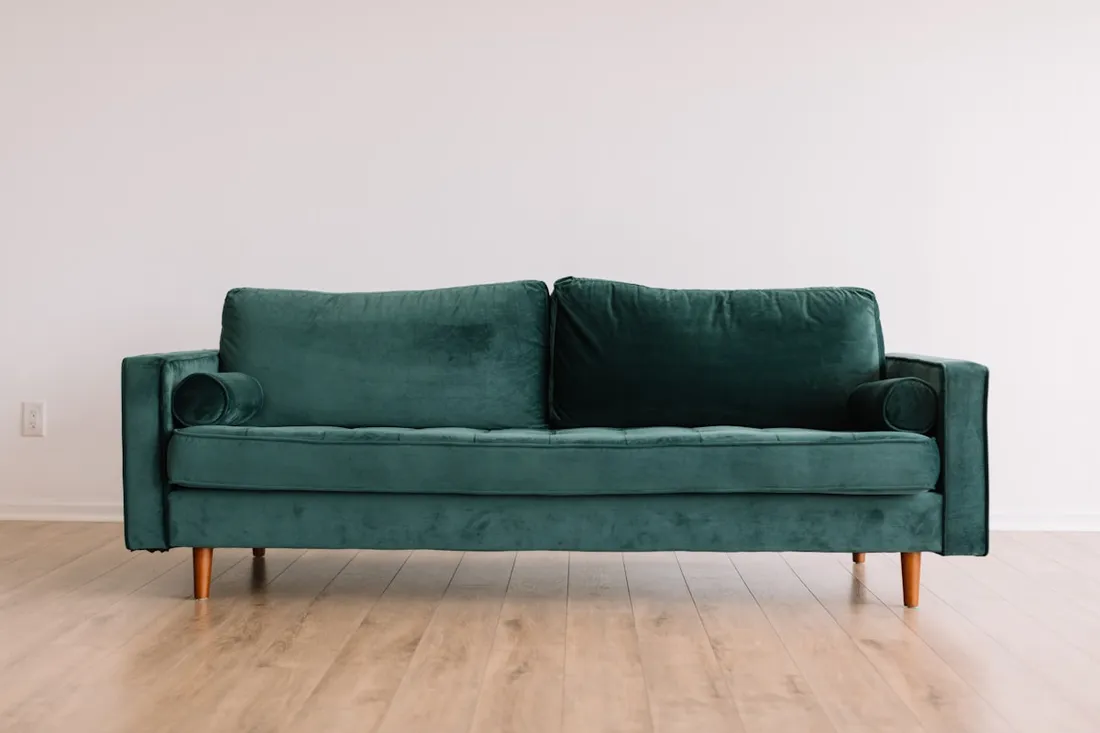
Last fall I bought a curved bouclé sofa. Cream-colored, low-profile, gently arced like it belonged in a Milanese hotel lobby. I assumed it would immediately soften my boxy rental living room (the 90-degree corners, the flat walls, the relentless rectangularity of the whole space). Instead, it made every other piece of furniture look architecturally wrong, like someone had dropped a cloud into a spreadsheet. And figuring out exactly why sent me down a rabbit hole that completely rewired how I think about furniture geometry.
One Curve in a Box: Why the Tension Is the Point
Here’s the thing every curved furniture guide gets wrong: they tell you to “commit to the curve.” Add a round coffee table. Get an oval rug. Swap your rectangular bookshelf for an arched one. Before you know it, your living room looks like the inside of an egg, soft, rounded, and weirdly devoid of structure.
Don’t do this.
A single curved sofa in an otherwise angular room creates something designers call formal tension, the contrast between organic and geometric shapes that makes your eye move around a space instead of settling into visual monotony. It’s the same reason a single piece of driftwood on a clean shelf looks interesting but a pile of driftwood looks like a mess. The contrast is doing the work. Remove the contrast and you’ve removed the interest.
I’ve written before about why rooms need a clear reason behind every choice, and this is a perfect case study. The curved sofa isn’t there to start a theme. It’s there to break one, strategically, in a way that gives the whole room energy it didn’t have before. A fully “curved out” room just reads as a pillow showroom. One curve among boxes? That’s a room with a point of view.
Reading Your Room: Which Floor Plans Fight the Curve and Which Welcome It
Not every boxy room responds to a curved sofa the same way. Before you start rearranging, stand in your doorway and look at what you’re working with.
Rooms that welcome a curve:
- Longer rectangular spaces where the sofa can anchor the middle third. The arc creates a natural conversation zone without needing a room divider.
- Open-plan living areas where the sofa’s back becomes a soft boundary between zones. This is where floating it really pays off (more on that in a minute).
- Rooms with at least one architectural detail that isn’t a straight line (an arched doorway, a bay window, a rounded column). The sofa has something to echo, even if everything else is angular.
Rooms that fight it:
- Very small square rooms (under 12x12 feet). The curve eats floor space in the corners and makes the room feel tighter, not softer. I tested this by sketching my old studio layout to scale on graph paper. The curved sofa created dead zones behind each end that were too small to use but too big to ignore.
- Narrow rooms where you’d need to push the sofa against a wall. A curve against a flat wall is like hanging a round painting in a rectangular frame. The mismatch highlights both shapes in the worst way.
- Rooms with built-in cabinetry or shelving along the facing wall. All those straight horizontal lines stacked up against one gentle arc creates a visual argument, not a conversation.
If your room falls in the “fights it” category, this doesn’t mean a curved sofa can’t work. It means you’ll need to be more deliberate about placement, and probably more willing to let go of a piece or two that’s compounding the problem.
The Rug Problem (And Why Rectangular Is Usually Right)
I spent two weeks agonizing over this. Every styled photo of a curved sofa I found online had a round rug underneath it. Made sense visually, curve echoes curve. So I borrowed a 6-foot round jute rug from Sarah to test it. (Yes, jute. I know. I have a complicated history with jute. This one was hers and therefore not my problem when it started shedding.)
The round rug looked… fine. But it created a weird island effect. The sofa and rug became their own little universe, visually disconnected from the rest of the room. The rectangular room felt more rectangular by comparison, not less.
Then I put my old 8x10 rectangular rug back. And something clicked.
The rectangular rug grounds the curved sofa in the geometry of the room. It says: this sofa belongs here, in this space, among these shapes. The curve reads as intentional contrast rather than an object that wandered in from a different apartment. The straight edges of the rug meet the straight edges of the walls and floor, and the sofa’s arc becomes the one deliberate interruption.
A few specifics on sizing:
- The rug should extend at least 12-18 inches beyond each end of the sofa’s curve. If the rug stops where the sofa stops, it looks like the sofa is sitting on a placemat.
- Front legs on, back legs off works here the same as it does with a straight sofa. It anchors without confining.
- If you’re set on a round rug and nothing I’ve said dissuades you (fair enough, I go back and forth on this), size way up. An 8-foot round minimum for most curved sofas, which means you’re spending real money. The Loloi Layla in the 9-foot round runs about $350 and doesn’t look like a rug trying too hard.
Float It, Don’t Wall It: Placement Rules That Change Everything
This is the single biggest mistake people make with curved sofas, and I made it too. Day one, I pushed mine against the longest wall. It looked terrible. The curve flattened visually, the wall highlighted the gap behind the arc’s apex, and the whole thing read as a regular sofa having a bad day.
A curved sofa needs to float. Pull it away from the wall by at least 18 inches, ideally 24-30 inches if your room allows it. The space behind the curve isn’t wasted; it’s what lets the shape breathe. You can put a narrow console table back there, a floor lamp, even just leave it empty. The point is that the curve exists in space, not against a surface that contradicts it.
Here’s where it gets good for boxy rooms: a floated curved sofa breaks the grid that your walls, windows, and existing furniture have established. Suddenly the room has a foreground and a background. There’s depth. The sofa’s back creates a soft edge that your eye reads differently than a wall or a shelf. This is basic spatial psychology, where curved forms register as approachable and safe, while angular forms register as structured and stable. You want both in the same room.
Floating rules for renters (because I know most of you, like me, can’t drill into anything):
- Use the sofa’s back as a zone divider in open-plan spaces. The arc naturally creates an “inside” and “outside.”
- Angle it slightly, 10 to 15 degrees off parallel to the wall behind it. This sounds fussy, but it’s the difference between “intentionally placed” and “couldn’t decide where it goes.” I measured mine with a tape measure and Danny’s phone compass, which is the most Portland sentence I’ve ever written.
- Don’t center it on the wall unless the room is symmetrical. In most rental living rooms with off-center windows or an awkward door placement, centering the sofa on the wall just draws attention to the asymmetry. Place it where the seating makes conversational sense, not where it splits the wall evenly.
Which Angular Pieces Stay and Which Have to Go
Here’s where people panic. The curved sofa arrives, nothing else matches, and the impulse is to replace everything. Resist that. Most of your angular furniture should stay. That’s the whole point. You want the tension.
What stays:
- Your rectangular bookshelf. Straight vertical and horizontal lines are the counterpoint that makes the curve read as a curve. Without them, it’s just furniture.
- Square or rectangular side tables. A boxy end table next to a curved sofa arm is genuinely beautiful contrast. The sharp corner meets the soft edge. I use a vintage teak cube I found on Facebook Marketplace for $45, and it’s one of the best pairings in my living room.
- Straight-lined media consoles, credenzas, buffets. Anything along the wall should stay angular. It reinforces the room’s bones.
- Your existing dining table, if it’s in the same open space. Especially if it’s rectangular. Don’t even think about swapping it.
What probably has to go:
- A second straight sofa facing the curved one in a mirrored arrangement. Two different sofa shapes facing each other reads as a furniture store showroom, not a living room. Replace the straight sofa with a pair of angular armchairs. The CB2 Gwyneth chair ($699) or, on a budget, IKEA’s KOARP ($249) both have clean lines that play well against a curve.
- Oversized recliners positioned at the curve’s endpoints. They crowd the arc and flatten it visually. A slim accent chair works; a La-Z-Boy does not.
- Any piece that’s touching the sofa’s curved back. Nothing should press against the outside of the arc. That includes storage ottomans, plant stands, and the pile of stuff that accumulates there. (I’m talking to myself here.)
Everything else? Keep it. Seriously. A curved sofa doesn’t demand a curved room. It demands a room that knows it’s angular and owns it, with one deliberate exception. That’s what lasting design actually looks like, pieces that hold their own against each other instead of blending into sameness.
Does a Round Coffee Table Help or Make It Worse?
I’ve been going back and forth on this for months, so I’ll give you the honest answer: it depends, but probably not for the reason you think.
A round coffee table in front of a curved sofa is the obvious move. The curve of the sofa mirrors the curve of the table. It’s harmonious. It’s cohesive. And in most rooms, it’s too much agreement. The sofa and table start singing the same note, and instead of creating a dynamic seating area, you’ve created a soft little pod that doesn’t engage with the rest of the room.
What actually works better in a boxy room: a rectangular coffee table with rounded corners. That’s the bridge piece. It speaks both languages: the straight sides relate to the angular room, the rounded corners relate to the sofa. It’s a translator, not a mirror.
Specific picks at three price points:
- Budget: IKEA STOCKHOLM coffee table in walnut veneer ($249). Soft-radius corners, clean lines, and it weighs enough that it feels like real furniture when you set your coffee down. You can feel the solidity.
- Mid-range: Article Nera rectangular coffee table in oak ($399). Slightly rounded edges, Scandinavian bones. Pairs beautifully with curves without going full circle. If you’re drawn to that Scandinavian-influenced look, this is the one.
- Investment: Room & Board Hayes coffee table ($899). Solid wood, American-made, radius corners that are subtle enough to miss until you run your hand along the edge. That’s the kind of detail that separates good furniture from disposable furniture.
If you already own a rectangular coffee table with hard corners, keep it. I’m serious. The sharp geometry against the sofa’s curve is visually interesting. You don’t need to replace a perfectly good table just because a blog told you everything needs to match. (Including this blog. Keep the table.)
Three Configurations That Prove You Don’t Need to Start Over
I tested these in my own living room, a 14x11 rectangular rental with one window on the short wall and the entry door on the long wall. Nothing fancy. No architectural details worth mentioning unless you count the ceiling fan Danny refuses to let me remove.
Configuration 1: The Conversation Arc Curved sofa floated 24 inches from the long wall, angled about 10 degrees. Two angular armchairs facing the sofa’s inner curve at slight opposing angles. Rectangular coffee table centered in the gap. Rectangular 8x10 rug anchoring all of it. Every other piece in the room (bookshelf, media console, side tables) stays angular and against the walls. The sofa is the only curve. It’s the star without being a diva.
Configuration 2: The Zone Divider Works best in open-plan or long rectangular rooms. Curved sofa perpendicular to the long walls, floating with its back toward the dining area or entry. The arc creates a natural threshold between zones. A narrow console table (I use a $60 thrift find, 48 inches long) sits behind the sofa’s outer curve. No coffee table; instead, a pair of small side tables inside the arc. The curve does the spatial work that a wall or partition would normally do, but softer and without blocking sightlines.
Configuration 3: The Corner Anchor This one surprised me. Curved sofa placed in a corner, endpoints about 16 inches from each wall, with the apex of the curve pointing into the room. It turns a dead corner into the primary seating zone. One angular accent chair at a 45-degree angle closing the conversational triangle. Round side table between the chair and sofa endpoint, and this is the one place a round accent piece earns its spot, because it softens the corner junction without competing with the sofa’s curve. A rectangular rug extends from under the sofa toward the room’s center, pulling the arrangement into the broader space.
All three of these kept my existing bookshelf, my existing media console, my existing side table, and my existing rug. The only thing I moved was the sofa itself and, in one case, a chair. That’s it. No full overhaul. No “organic shape collection.” One curve doing exactly enough work to change the whole room.
The best version of your living room probably isn’t the one where everything agrees. It’s the one where most things agree and one thing (one good, deliberate, well-placed thing) doesn’t.