Entryway Styling: The Five-Element Formula That Makes Every Arrival Feel Like Coming Home
Console, mirror, light, rug, one living thing: the five-element entryway formula that turns a bare 4-foot corridor into the most intentional room in your home.
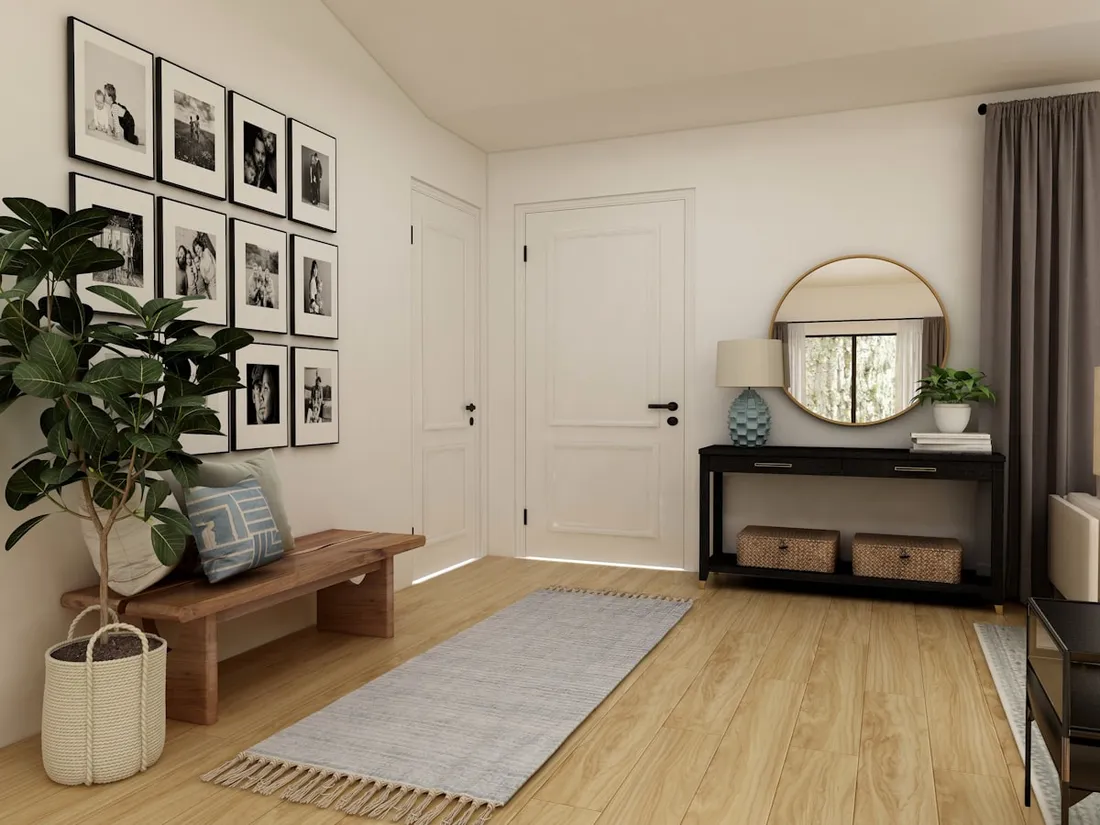
Your entryway makes its case in about thirty seconds. Not your living room, not your kitchen, not the gallery wall you spent four weekends arranging. The first few feet past the door does more work than any other square footage in your home, and most entryway advice boils down to “add a console table and a mirror,” which is about as useful as saying the secret to cooking is “use heat.”
The 30-Second Test: What Your Entryway Is Saying Before You Say a Word
Environmental psychologists call it “affective appraisal”: the brain’s snap judgment of a space before conscious thought kicks in. Within seconds of crossing a threshold, your nervous system has already decided if a place feels warm or cold, intentional or neglected. Your entryway is the thesis statement for every room that follows.
Here’s the contrarian take most design blogs won’t give you: stop trying to make your entryway feel bigger. That’s the standard advice, and it produces spaces that feel like hallways pretending to be something else. Mirrors placed to “open things up.” Light colors chosen to “expand” four feet of wall. The result is a space with no identity. Just a transition zone you walk through without registering.
The entryways that actually land are the ones that commit to being a distinct room. Even if that room is 36 inches deep. Especially then. A small space with a clear purpose reads as intentional. A small space trying to look large reads as apologetic. (I wrote more about this idea in the case for intentional design, and it applies here more than almost anywhere.)
When I moved into my current apartment, the “entryway” was four feet of wall between the front door and the living room. No foyer. No mudroom. No architectural separation whatsoever. I stuck a $60 secondhand console table against that strip of wall and hung a thrift-store mirror above it. That was it. And something shifted. That strip of wall became the first thing I noticed coming home every night and the last thing I tidied before having people over. It became a room, even though it technically wasn’t one.
The Five-Element Formula: Console, Mirror, Light, Rug, One Living Thing (In That Order)
Order matters here. Not because there’s some sacred design hierarchy, but because each element solves a specific problem, and the problems build on each other.
Element 1: A surface. You need somewhere to put things down. Keys, mail, the sunglasses you’ll forget about until next Saturday. A console table is the standard answer, but it doesn’t have to be. (More on alternatives in a second.) The point is: something between hip and waist height, flush to the wall, that says “things go here.”
For a proper console, the Safavieh Christa Console Table ($180-220) is surprisingly solid for the price. Real wood, comes in a few finishes. If you’ve got more room and budget, the West Elm Mid-Century Console ($399, but wait for their 20% off sales, which happen roughly every six weeks) has been a reliable recommendation for years. At the investment end, Room & Board’s Berkeley Console ($799) will outlast your lease and probably your next one too. The wood is dense enough that you can feel the difference when you set something down on it. That little thud of something landing on solid walnut instead of the hollow tap of particleboard. It matters more than it should.
Element 2: A mirror. Not for “opening up the space.” For two practical reasons: checking yourself on the way out the door (functional) and bouncing whatever light exists back into the entry (optical). Size-wise, the mirror should be no wider than your console and roughly two-thirds as tall as the wall space above it. The Target Threshold Rounded Rectangle Mirror ($60) does the job honestly. For something with more character, CB2’s Infinity Mirror line or a vintage frame from your local estate sale circuit.
Element 3: Ambient light. Not overhead. Never overhead in an entryway. (I’ll dig into this below.) A table lamp on the console, a wall sconce if you can install one, or a plug-in sconce if you’re renting. You want warm light, 2700K, hitting the wall at about face height. The goal is to feel welcomed, not interrogated.
Element 4: A runner or small rug. This does three things: defines the territory (“this is the entryway, that is the living room”), protects whatever flooring you’ve got, and gives texture underfoot. A 2x3 or 2.5x8 runner in something durable. Wool holds up. Jute does not. (I have $400 worth of personal experience confirming this. The pilling. The shedding. The betrayal.) Ruggable’s washable runners ($89-129) are genuinely practical for high-traffic entries. Loloi’s Chris Loves Julia line has good wool-blend options around $60-100 for a 2x3.
Element 5: One living thing. A plant, a small vase of clippings, a single branch in a ceramic vessel. Something organic that breaks up the geometry of everything else. If your entry gets zero natural light, a pothos in a simple pot will survive. They always survive. Mine has survived things I won’t describe publicly.
When You Don’t Have Room for a Console Table
If your entryway is truly narrow (under 30 inches of walkable width once you account for the door swing), a console table will turn it into an obstacle course. Here’s what works instead:
- A floating shelf at console height. The IKEA LACK shelf ($12.99, and yes, a thirteen-dollar shelf can look intentional) mounted at 30-32 inches gives you a surface without eating floor space. Add a small hook strip below it for keys.
- A wall-mounted drop-leaf table. Folds flat when you don’t need it. Opens up when you’re sorting mail. Wayfair has a few under $100 that actually hold up.
- A narrow bench. The IKEA TJUSIG bench ($60) is only about 17 inches deep. It gives you a place to sit and pull shoes off while also holding a tray for keys on top. Two problems solved.
The formula still applies. You’ve just scaled down element one. Mirror, light, rug, plant: all still go.
What Actually Lands on the Hook Versus What You Wish Would
Let’s be honest. Every styled entryway photo shows a single straw hat, one canvas tote, and a linen jacket arranged like a still life. Your actual entryway has a puffy coat that weighs four pounds, a tangle of reusable grocery bags, two umbrellas (one broken), and a dog leash.
Design for the real pile, not the imagined one. This means:
- More hooks than you think. A row of five or six, not two. The Command strip variety is fine for renters. The Schoolhouse Utility Hook ($18 each, but they’re forever-quality brass) if you can drill into studs. Over-the-door hooks if you can’t do either.
- A tray or basket on the console for the daily dump: keys, wallet, loose change, the random receipts that multiply overnight. The Target Threshold Woven Basket ($15) or a simple ceramic tray.
- A shoe solution that acknowledges shoes exist. A low basket tucked under the console. A boot tray in wet months. The IKEA STÄLL shoe cabinet ($89) if you’ve got the wall space. It’s only about 10 inches deep and holds a surprising amount.
The goal isn’t hiding everything. It’s giving everything a place so the visual default is “tidy” even when you haven’t actively tidied in three days.
Japandi, Mediterranean, Coastal, Maximalist: How the Same Five Elements Look Completely Different
The formula doesn’t change. The materials and mood do.
Japandi (and I’ll say what I always say: the term oversimplifies two rich traditions, but the aesthetic shorthand is useful here): light oak console, round mirror with a thin black frame, ceramic table lamp in matte white, a flat-weave runner in undyed wool, and a single stem in a narrow bud vase. Everything low-contrast. Nothing shiny. The feeling you’re going for is “quiet exhale.” If you want more on the Scandinavian side of that equation, lean into the lighter woods and skip the darker Japanese ceramics.
Mediterranean pulls from a completely different register. Think a warm plaster wall (or the renter-friendly equivalent: a limewash paint like Portola’s Roman Clay in Panna Cotta), an arched mirror with an aged brass frame, a terracotta table lamp, a vintage-looking runner in rust and cream, and a small potted herb. Rosemary, specifically. It smells incredible every time you brush past it on the way in. That kind of sensory layer is what separates a styled space from a space someone actually lives in.
Coastal (done right, not the “Live Laugh Beach” version): a white or driftwood-toned console, a round rope-frame mirror, a woven rattan lamp, a blue-and-cream striped runner, and a bowl of collected rocks or shells. Real ones. From actual trips you took. Not a bag of decorative shells from HomeGoods. The difference between those two things is obvious to every person who walks in, and pretending otherwise doesn’t help anyone.
Maximalist: saturated color on the wall (the entryway is the safest place to experiment with bold paint because it’s small and you see it briefly), an ornate mirror, a lamp with a patterned shade, a runner with actual personality (vintage Persian runners on eBay go for $40-80 for a worn-in 2x6), and a trailing plant in a bright ceramic pot. The maximalist entryway says “buckle up.” I genuinely love that energy.
The Lighting Layer Most Entryways Get Wrong
I’ve written about lighting as the single most impactful change you can make in any room. In entryways, the stakes are even higher because the space is small and first impressions form fast.
The mistake almost everyone makes: relying on the overhead fixture. That builder-grade dome light on the ceiling casts flat, shadowless light straight down, which is the least flattering angle for every surface and every face. You walk in and everything looks institutional. Not great for a thesis statement.
Kill the overhead. Or at least demote it. Put it on a dimmer if you can, or simply leave it off. Instead:
- A table lamp on the console as your primary source. Something with a fabric or linen shade that diffuses warmth. The Target Threshold Ceramic Table Lamp ($25-35) is a reliable starting point. For something with more design intent, Rejuvenation’s Eastmoreland Table Lamp ($199) is beautiful and built to last.
- A plug-in wall sconce if you’re renting and can’t hardwire. Schoolhouse’s Isaac Plug-In Sconce ($179) or the much cheaper IKEA SKURUP wall lamp ($15). Both work.
- A candle. Seriously. If you’re coming home at the end of the day and your entryway has a lit candle on the console, you’ll feel something. It’s corny. It works. Every single time.
Warm light (2700K) is non-negotiable here. Anything cooler reads as commercial. You’re building a transition between the outside world and your home. That light should feel like a downshift, not a spotlight.
Why Your Entryway Should Look Slightly Better Than the Rest of Your Home
This sounds like I’m telling you to fake it. I’m not. I’m telling you to front-load your effort.
Your entryway is the smallest room (or room-adjacent space) in your home. That makes it the cheapest and fastest to get right. A good console, a mirror, a lamp, a rug, a plant. Five elements. You could source all of them in a single weekend for under $200 if you hit a thrift store and Target in the same trip.
And because it’s the first and last thing you see every day, it has an outsized impact on how your home feels overall. A beautifully styled entryway followed by an imperfect living room reads as “this person has taste and they’re still working on things.” Which is true of everyone, always. An unstyled entryway followed by a gorgeous living room reads as “the good stuff is hidden.” You don’t want to hide it.
I think about my four-foot strip of wall a lot. It’s not magazine-worthy. The console has a scratch on it from when Danny misjudged the door with a grocery bag. The mirror is slightly too small. (I know this, and I don’t care enough to replace it yet.) But it works. It catches me every single night when I come through the door. The lamp is already on because it’s on a $10 outlet timer. The keys go in the tray. My coat goes on the hook. And for a half-second, before Cashew starts yelling about dinner, the apartment feels like it’s glad I’m back.
That’s the whole point. Not a bigger space. Not a more stylish one. Just one that notices you arrived.